
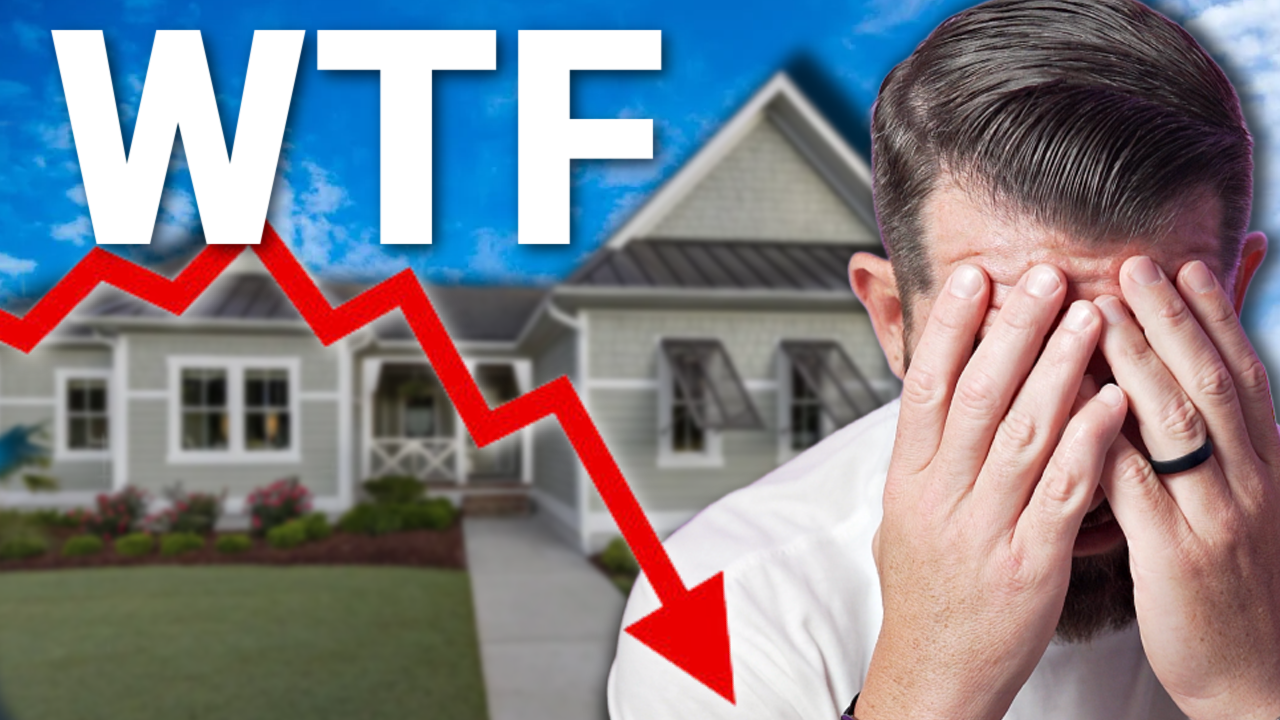
WTF Just Happened To The Housing Market?!
The Educated Homebuyer Podcast
What Actually Happened to the Housing Market in 2026 (And What It Means If You Want to Buy)
Everyone expected this to be the breakout year. Instead, the spring market stalled. Here is what the data actually says and what to do about it.
Everyone expected 2026 to be the year the housing market finally turned the corner. After three years of historically low transaction volume, this was supposed to be the breakout. More inventory, more sales, and maybe just enough breathing room for buyers who have been sitting on the sidelines to finally make a move.
Instead, the spring market stalled. Sales are sluggish, inventory growth has slowed to a near standstill, and first-time homebuyers just hit the lowest share of the market ever recorded. So what is actually going on? And if you are trying to buy a home right now, does any of this actually matter?
The short answer is: it matters, but probably not in the way you think.
The Market That Was Supposed to Break Out
To understand where we are, you have to understand where we were supposed to be.
Since 2022, existing home sales have hovered around 4 million on an annualized basis. For context, a healthy market with the current U.S. population should be closer to 5 million sales per year. That means the market has been running about 20 percent below what would be considered normal for three straight years.
The expectation heading into 2026 was that things would finally start to normalize. Not fully recover overnight, but begin the climb. Analysts like Logan Mohtashami at HousingWire were projecting somewhere in the range of 250,000 additional sales compared to 2025. Nothing dramatic, but a measurable step forward.
Through the end of February, that trajectory looked roughly on track. Then everything changed.
What Derailed the Spring Market
A few things collided at once, and the timing could not have been worse.
Mortgage rates, which had been ticking down and were approaching their lowest levels in three years, suddenly reversed course. Geopolitical events introduced fresh uncertainty. Buyers who had been quietly preparing to enter the market over the spring pulled back. Purchase applications tracked by the Mortgage Bankers Association dropped sharply for three to four consecutive weeks.
The psychological impact of that pause is worth understanding clearly. The spring season is not just busy because of weather or tradition. It is busy because of momentum. When buyers, sellers, and homeowners all believe conditions are moving in a favorable direction, that collective confidence generates activity. Listings come out, offers get written, deals close. The summer numbers that everyone credits to warm weather are largely a function of contracts that were signed in April, May, and early June.
When something disrupts that momentum, you cannot simply get it back. The families who had a plan to be in a new home before the school year started, that window is closing. That is demand that does not roll over to next quarter.
It disappears from 2026 entirely.
What the Inventory Numbers Are Actually Telling You
Inventory is a word that gets thrown around constantly in real estate conversations, but the details matter far more than the headline.
Year over year, inventory is still up. But the growth rate has collapsed. Last year, inventory was expanding at over 33 percent annually. That number is now around 3 to 4 percent. Week over week, the market is essentially flat.
That shift carries two important implications depending on where you sit.
For buyers, the fast surge in inventory last year created real leverage in certain markets. More homes meant more options, more negotiating room, and less pressure to overpay. That environment has softened considerably. The selection is still better than the post-pandemic drought years, but the window of relative buyer advantage is narrowing.
For sellers, the fact that inventory is not piling up is actually stabilizing news. A flat or slow-growth inventory environment does not produce the kind of supply-demand imbalance that drives prices down meaningfully. There is no flood of homes hitting the market without enough buyers to absorb them. That scenario is not the current reality in most parts of the country.
Your Location Changes Everything
National housing data is useful for context, but it is a terrible guide for making personal decisions.
The United States is not one housing market. It is thousands of local markets that often move in opposite directions at the same time. Right now, some parts of the Southeast and parts of Texas have inventory levels that give buyers real options. Prices in pockets of those areas have softened. Buyers there are in a meaningfully different situation than buyers in constrained coastal markets.
California is a clear example of that contrast. Within the state, you can find markets where prices have dipped slightly and markets where they have continued to climb. Orange County and the Huntington Beach area specifically remain supply-constrained. Buyers in that environment are competing in a fundamentally different market than someone buying in the suburbs of Austin or Jacksonville.
This is why working with someone who knows your specific market is not just a nice-to-have. It is the difference between making a confident decision and making one based on information that does not actually apply to your situation.
Ready to Understand Your Specific Situation?
If you are trying to figure out whether now is the right time for you, the first step is getting clarity around your numbers and options. Stop guessing. Start building a real strategy.
Start Here →The Interest Rate Picture Is Better Than You Think
Here is something that rarely gets communicated clearly in mainstream coverage.
Mortgage rates right now feel elevated relative to the pandemic-era lows of 3 percent. That comparison is real. But it is also an unhelpful reference point for anyone trying to make a current decision, because those rates were the result of emergency monetary policy that will likely never be repeated.
A more useful comparison is what a well-qualified buyer can actually get right now. Rates for strong borrowers are available under 6.5 percent and tracking back toward 6 percent. A year ago, if you had told most buyers that well-qualified borrowers could lock in a 30-year fixed around 6.25 percent, the majority would have said yes immediately.
There is also a technical factor that rarely gets explained to buyers: the mortgage spread. This refers to the difference between the yield on the 10-year Treasury and the rate on a 30-year mortgage. Historically, that spread has been tighter. Right now it is running over 2 percent. If the spread were to compress back toward historical norms, mortgage rates would drop meaningfully without any change from the Federal Reserve. That is a tailwind that does not get reported on, but it is real.
The practical takeaway is that the rate environment is genuinely better than many buyers assume once they actually sit down and run the numbers with a knowledgeable mortgage professional. The perception is often worse than the reality.
First-Time Buyers Are Feeling This the Most
The most significant data point in all of this may be the one that gets the least attention.
First-time buyers now represent just 21 percent of the market. During the low-rate environment of the pandemic, that number was closer to one in three buyers. Today it is closer to one in five.
That decline is not just a statistic about a group of people. It has consequences that ripple through the entire housing ecosystem.
The housing market moves like a staircase. First-time buyers purchase entry-level homes. That frees up existing homeowners to move up. Move-up buyers then open inventory for the next tier. When first-timers cannot enter the market, the whole staircase stalls. Sellers at the bottom rung have no one to sell to, so they do not list. That reduction in listings constrains options for move-up buyers, who then stay put. The chain reaction runs in both directions.
Affordability is the primary driver. At current prices and rates, the math is genuinely difficult for many first-time buyers, especially in high-cost markets like Orange County and Southern California broadly. That difficulty is not going away in the near term. What can change is your individual position within that reality. And that is entirely within your control.
If You're Trying to Buy Right Now, Here Is What Actually Matters
The market is uncertain. That is the honest assessment. But uncertainty about the broader market is not the same as uncertainty about your own situation, and conflating the two is one of the most common and costly mistakes buyers make.
The families who are the most composed right now, who are moving forward with confidence rather than anxiety, share something in common. They have done the foundational work. They know their purchasing power. They understand their loan options. They know how much cash they need and where it is coming from. They have a roadmap.
When you have that clarity, the noise from geopolitics, rate volatility, and economic headlines does not hit you the same way. You can separate the things that genuinely affect your decision from the things that are just noise.
If you are trying to buy in the next three to twelve months, the most valuable thing you can do is not monitor the market more closely. It is to understand your own situation more precisely. That means working through a full pre-approval process, not a basic qualification number. It means understanding what loan programs are available for your specific credit and income profile. It means knowing exactly how much home you can buy at the monthly payment you are comfortable with, and what tradeoffs you are actually making.
The Buyers Who Are Getting Left Behind
One pattern that keeps showing up is buyers who are waiting for a trigger that will never come.
They are waiting for rates to drop to some threshold they have arbitrarily decided is acceptable. They are waiting for prices to fall before they get serious. They are waiting for confidence to return to the market before they take any action toward readiness.
The problem is that these conditions tend not to arrive in clean, obvious, simultaneous fashion. Rates move quickly, sometimes over a single week. When they drop meaningfully, buyer activity picks up fast. The window to act before competition increases can be short.
The buyers who are positioned to move when opportunity appears are the ones who have already done the preparation. They have their financing dialed in. They know their target areas and price points. When the right home comes to the market, they can make an offer the same day if they need to.
There is a version of this that plays out in the current market specifically because of how inventory is positioned. Homes in strong locations at realistic prices in markets like Huntington Beach and broader Orange County are still moving. Quality inventory does not sit. If you are not prepared to act, you are effectively not in the market even if you think you are.
What Groundhog Day in Real Estate Actually Means
There is a phrase that captures the current moment well: Groundhog Day. For the third or fourth time in recent years, a turning point appeared on the horizon. Buyers and sellers started to move toward it. And then something unexpected hit, slammed the brakes, and reset the clock.
For anyone trying to time that turning point, this is genuinely frustrating. For anyone who understands that their personal situation is the real timing variable, it is much less important.
The market will normalize eventually. Transaction volume will climb back toward 5 million. Inventory will gradually increase. First-time buyers will find their way back into the market as affordability improves incrementally through a combination of income growth, modest price cooling in certain markets, and lower rates.
That normalization may not happen in 2026. It may not happen in 2027. But if you are buying a home with a genuine five to seven year or longer time horizon, and your life circumstances are telling you now is the time, the question of whether 2026 ends up at 4.1 million or 4.3 million annualized sales is almost completely irrelevant to your outcome.
What is not irrelevant is whether you bought the right home, at a payment you can sustain, with a loan structure that serves your goals, and with enough financial cushion to weather normal uncertainty. Those variables are yours to control. The market is not.
The Honest Summary for Buyers in Orange County and Southern California
If you are trying to buy in the Huntington Beach area, Orange County, or anywhere in the constrained coastal California markets, here is the clearest possible framing of where things stand.
Prices are not meaningfully falling and are not expected to. The supply conditions that would drive a significant correction do not exist here. Inventory is growing slowly but remains well below balanced market levels. Quality homes in good locations are still attracting real competition.
Rates are better than most people expect when they actually run the numbers with a knowledgeable mortgage professional. The psychological barrier is real; the financial reality is often more workable than the headlines suggest.
First-time buyers face real affordability headwinds, but there are programs designed for this market that many buyers do not know exist. FHA, VA, and conforming loan options each have specific use cases, and the right structure depends on your individual situation, not what a general article online tells you to do.
The buyers who will look back on this period positively are not the ones who perfectly timed the market. They are the ones who got clear on their goals, built a real financial plan, found the right professional partners, and executed when their life was ready, not when headlines told them to.
That is what buying right and borrowing smart actually looks like in practice.
Build Your Strategy. Stop Guessing.
If you are serious about buying right and borrowing smart, the next step is not waiting for a better headline. It is building a strategy around your income, your goals, and your long-term plan. That process starts with one conversation.
Start Here →
How to Buy a New Home Without Selling Your Current One (Real Story)

 Spotify
 Apple Podcasts
 Castro
 RSS Feed